Looking forward to the Women in Spanish and Portuguese Studies Annual Conference, hosted by the University of Exeter, on 31 October and 1 November 2025! This year’s theme is Transforming Narratives: Conference 2025 | WISPS
Prof. Katharine Murphy will be presenting research for the Reading Bodies project on ‘Writing for Women’s Health: Maternal Exhaustion and Societal Constraints in Carmen de Burgos’ La rampa (1917)’. Thanks to the organisers of this year’s WISPS conference!
A collection of articles by the project research network for an extended special issue ofJournal of Romance Studies 25.3 (2025), 293-530 on ‘Reading bodies: Narrating illness in European literatures and cultures (1870s to 1960s and beyond)’, edited by Katharine Murphy and Olivia Glaze, is now published! For more information about project outputs, please visit our Publications page.
As we reach the final stages of the Reading Bodies grant, here are some reflections on the shape, scope and challenges of the project over the last 20 months:
This AHRC-funded multilingual project has sought to address the under-representation of Hispanic Studies research in the wider field of Medical Humanities. To achieve this objective, the project has facilitated exchanges with specialists working on literary and cultural representations of health and illness in French, Portuguese, Italian and German Studies. It includes the following highlights:
Year One
Established an international Reading Bodies Research Network with specialists in the UK, Europe and USA, through regular online meetings to facilitate the exchange of ideas and perspectives.
Held academic workshops in 2024 at the Institute of Languages, Cultures and Societies (University of London) and University of Exeter;
Established partnerships with arts and cultural organisations, writers, artists and health professionals;
Developed an extended Special Issue with the Journal of Romance Studies on ‘Reading Bodies: Narrating Illness in European Literatures and Cultures (1870s to 1960s and Beyond)’, forthcoming in Autumn 2025.
Held an ‘in conversation’ online event about writing bodies and health with acclaimed author Sarah Moss. This interview aimed to establish connections between research on literary representations of health and illness in the late 19th and early 20th centuries and their relevance in the present day;
Disseminated our research findings via conferences such as the Association of Hispanists of Great Britain and Ireland, Edinburgh University (April 2025) and Northern Network for Medical Humanities Research 2025 Congress on ‘TONGUES: Medical Humanities across Linguistic and Cultural Frontiers’ (May 2025).
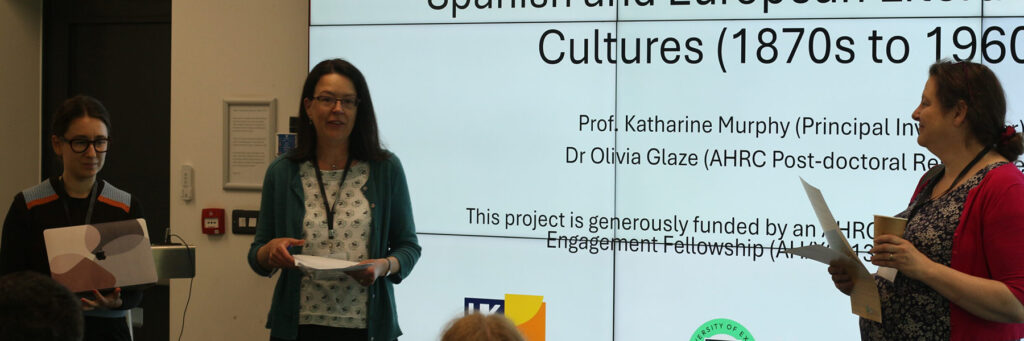
Thanks to all our wonderful speakers from the Universities of Belfast, Boston (USA), Cambridge, Exeter, Kent, London and Sheffield, for our second international Reading Bodies workshop, hosted by the University of Exeter on 23 May 2024. The workshop was organised by Prof. Katharine Murphy (Principal Investigator for Reading Bodies) and Dr Olivia Glaze (AHRC Postdoctoral Researcher). Prof. Nicolás Fernández-Medina (Chair of Romance Studies at Boston University) delivered a brilliant keynote on Health, Disease, and Society in the Early Ramón Gómez de la Serna. The programme included specialists in Spanish, Portuguese, English, French and German, and a hybrid Roundtable on interdisciplinary approaches to Reading Bodies in Literatures and Cultures.
We’re looking forward to our second international workshop, hosted by the University of Exeter on 23 May 2024. All are welcome to attend – please reserve your place here.
Highlights include speakers across 4 languages, a keynote by Prof. Nicolás Fernández-Medina (Chair of Romance Studies at Boston University), an interdisciplinary Reading Bodies Roundtable, and a Stage Rehearsal of Multilingual Medical Humanities (with Ants!). There will also be a short talk about Bibliotherapy by Exeter City of Literature. For more information about the programme, please visit our events page.
The second academic workshop for this project will be held at the University of Exeter on 23 May 2024. All are welcome to attend – please reserve your place here. For more information about the programme, visit our events page.
The Reading Bodies Research Network has met regularly since November 2023 to discuss our project research questions, updates on our chosen topics, and development of shared interests which are grouped into 3 themes: gender and the body; society, illness and representation; transnational and decolonial perspectives. For more information, please visit our Network and People pages.
By Isabel Cawthorn, PhD candidate in Hispanic Studies, University of Birmingham
Leopoldo Alas (‘Clarín’) is most prominently known as the author of La Regenta, which was published in two volumes in 1884 and 1885 and is now well ensconced in classic Spanish literature. However, aside from this realist novel, he also published hundreds of experimental short stories, of which ‘Cuervo’ was one, first appearing in the newspaper, La Justicia, in 1888. Clarín begins his short story, ‘Cuervo’, with the following lines: ‘El paisaje que se contempla desde la torre de la colegiata no tiene más defecto que el de parecer amanerado y casi casi de abanico. El pueblo, por dentro, es también risueño, y como está tan blanco, parece limpio’.[1] [‘The landscape that can be seen from the collegiate church has no other defect than appearing slightly affected and almost fan-like. The village itself is also pleasant, and because it is so white, it appears clean’.][2] The quotation foregrounds the importance of the concepts of cleanliness and ‘defect’ in relation to people and places. Specific to this story is how sanitation and disease are used to pathologise the past, making ‘Cuervo’ an interesting example of how, in late nineteenth-century Spain, pathology and illness were given a temporal significance.
Welcome to the AHRC-funded project on ‘Reading Bodies: Narrating Illness in Spanish and European Literatures and Cultures (1870s to 1960s)’ at the University of Exeter. As the Principal Investigator, my interest in this area of research has developed over several years, starting with representations of pathology in the works of turn-of-the-century Spanish author Pío Baroja. He studied medicine in Madrid and Valencia, submitting a doctoral thesis on ‘Pain. A Psychophysical Study’ in 1893, and practised for a short time as a doctor in the Basque town of Cestona before turning definitively to writing. His disillusionment with studying medicine is reflected in a famous semi-autobiographical novel, El árbol de la ciencia (1911) [The Tree of Knowledge].